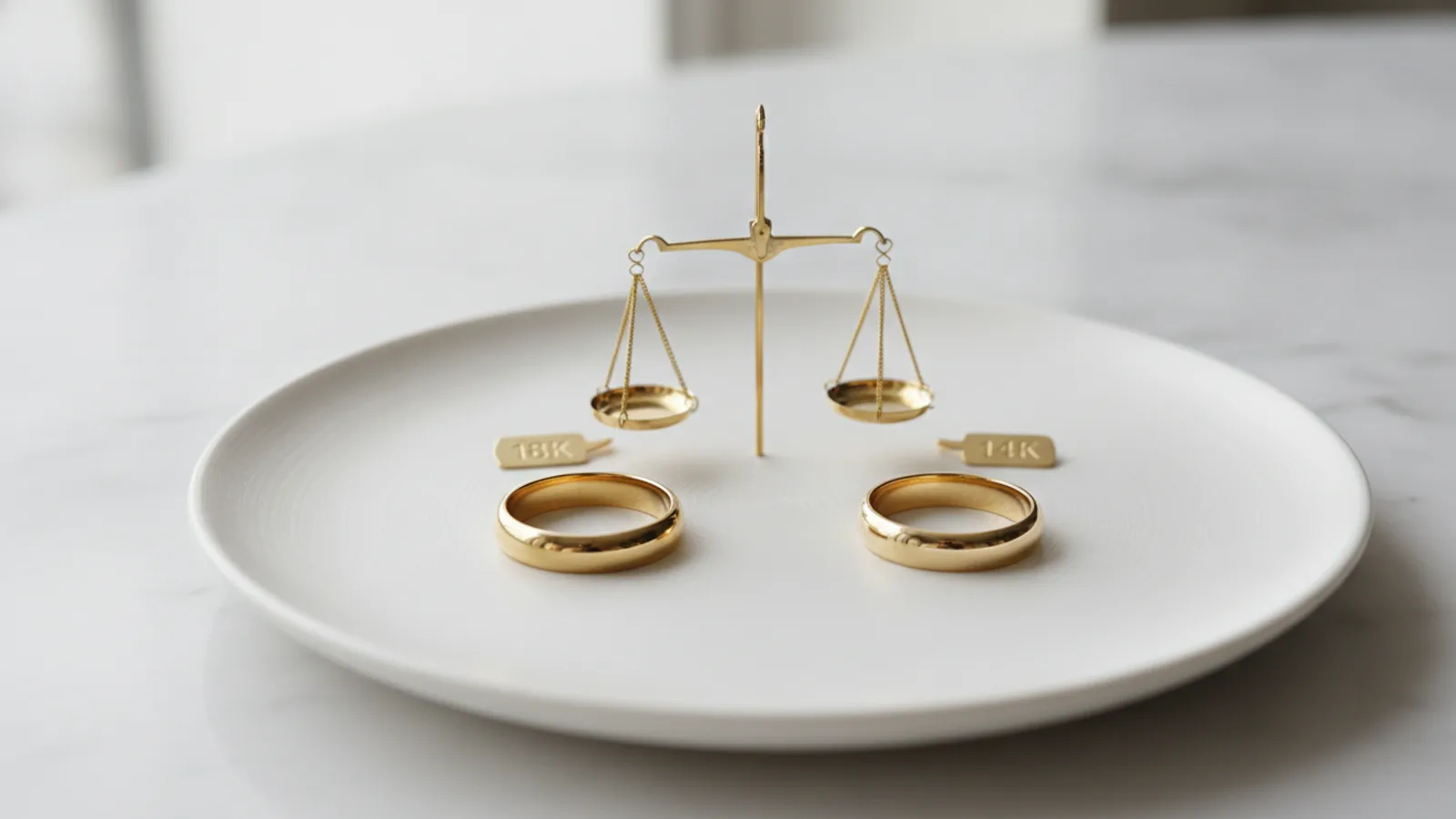
Head-to-head comparison
Overall winner: 14k Gold for its superior balance of durability, value, and appearance for daily wear.
For most people, 14k gold is the optimal choice, particularly for jewellery intended for frequent use like engagement rings and bracelets. It offers excellent resistance to scratching and bending at a more accessible price. 18k gold is the superior option for those who prioritise the highest purity and a richer, deeper colour, making it ideal for special occasion pieces where its softness is less of a concern.
This comparison is based on a systematic analysis of metallurgical standards, jewellery manufacturing best practices, and established patterns of consumer feedback. We do not perform in-house lab testing; our guidance is grounded in extensive industry research to help you make a practical, informed decision.
Choosing between 18k and 14k gold is a fundamental decision in buying fine jewellery. It's not simply a case of "good vs. better," but a strategic choice that impacts durability, appearance, and cost. 18-karat gold consists of 75% pure gold, delivering a luxurious, deep yellow hue. 14-karat gold contains 58.3% pure gold, with the remainder being stronger alloys that significantly enhance its durability. The ideal choice for you depends entirely on a clear assessment of your lifestyle, budget, and how you intend to wear the piece.
Option A
18k Gold
- Best for: Special occasion pieces, buyers with sensitive skin
- Strength: High purity and rich, vibrant colour
- Tradeoff: Softer, scratches more easily, higher cost
Option B
14k Gold
- Best for: Everyday wear, engagement rings, active lifestyles
- Strength: Excellent durability and great value for money
- Tradeoff: Less pure gold content, slightly paler yellow tone
Head-to-Head Scorecard
18k vs 14k Gold: Key Differences
Understanding the distinction between 18k and 14k gold comes down to one core concept: purity. The "karat" (k) system is a measure of the proportion of pure gold to other metals in a piece of jewellery. Pure gold is 24-karat, but it is far too soft to be used in durable jewellery. To create a workable and resilient material, gold is mixed with other metals like copper, silver, zinc, and palladium. This mixture is called an alloy.
- 18k Gold: Is 18 parts pure gold out of 24, or 75% pure gold. The remaining 25% is composed of alloy metals.
- 14k Gold: Is 14 parts pure gold out of 24, or 58.3% pure gold. The remaining 41.7% is composed of alloy metals.
This fundamental difference in composition creates four key distinctions that every buyer must consider:
- Durability: Because 14k gold has a higher percentage of strengthening alloy metals, it is significantly harder and more durable than 18k gold. It is more resistant to scratches, dents, and bending from daily activities.
- Colour: The higher concentration of pure gold in 18k gives it a richer, deeper, and more vibrant yellow tone. 14k gold has a slightly lighter, softer yellow hue, which many people still find very appealing.
- Cost: Price is directly linked to gold content. As 18k gold contains more pure gold than 14k, it is invariably more expensive.
- Hypoallergenic Properties: For those with metal sensitivities, particularly to nickel, 18k gold is often the safer choice. The lower percentage of alloy metals reduces the chance of an allergic reaction.
The choice is not about which is intrinsically "better," but which set of characteristics provides the best operational fit for your specific needs, lifestyle, and budget.
Measurement
Routine Fit: Durability
For any piece of jewellery intended for regular wear, durability is a critical system metric. Gold is a naturally soft metal. The addition of alloys is what provides the necessary hardness to withstand daily life. In this context, the higher percentage of alloys in 14k gold gives it a decisive advantage.
14k gold is substantially more resistant to scratches, scuffs, and dents compared to 18k gold. This makes it a much more practical choice for items that are exposed to frequent contact and potential impacts, such as engagement rings, wedding bands, and bracelets. An active person who works with their hands or simply doesn't want to worry constantly about damaging their jewellery will find 14k gold to be a far more forgiving material.
Conversely, the softness of 18k gold makes it more susceptible to damage. While it's perfectly suitable for carefully worn items like earrings or pendants, which are naturally more protected, it will show signs of wear much faster on a ring or bracelet. Choosing 18k gold for a daily-wear item requires a commitment to more conscious, careful use and more frequent maintenance.
Measurement
Formula: Purity and Appearance
The primary appeal of 18k gold lies in its formula: 75% pure gold. This high level of purity has two significant benefits: intrinsic value and a superior aesthetic. Visually, 18k yellow gold boasts a rich, warm, and deeply saturated yellow lustre that is unmistakably luxurious. This vibrant colour is closer to that of pure 24k gold and is highly sought after by those who want the most authentic and brilliant gold appearance.
While 14k gold is beautiful in its own right, its colour is noticeably lighter and less intense than 18k gold due to the higher proportion of other metals in the alloy. To an untrained eye, the difference may be subtle, but when placed side-by-side, the deeper, warmer glow of 18k is apparent. For connoisseurs and those making a statement with a special piece, this visual superiority is often the deciding factor.
It is important to note that for white gold or rose gold, the colour difference between 14k and 18k can be less pronounced. White gold is plated with rhodium, which dictates the final colour, while the copper content in rose gold is the primary colour determinant. However, for classic yellow gold, the distinction is clear.
Measurement
Ease of Use: Maintenance and Care
From a maintenance workflow perspective, 14k gold is the more user-friendly option. Its inherent hardness means it requires less frequent attention to maintain its appearance. It resists minor scratches and scuffs better, so it continues to look newer for longer with simple, routine cleaning. The need for professional polishing to remove accumulated signs of wear is less frequent than with its 18k counterpart.
18k gold, being softer, demands a more proactive care regimen. It will inevitably acquire a patina of fine scratches more quickly with regular wear. While some appreciate this as a sign of a well-loved piece, others will find themselves seeking professional polishing more often to restore its original high-lustre finish. Owners of 18k gold rings and bracelets must be more mindful during daily tasks, often removing them to prevent damage. This creates an additional layer of operational overhead in owning the piece.
Measurement
Value: Price and Long-term Value
When assessing value, it's crucial to distinguish between the upfront cost and long-term worth. 14k gold offers superior upfront value. The price of a gold item is heavily influenced by its "gram weight" of pure gold. Since 18k gold contains significantly more pure gold than an identically sized piece of 14k gold, it is always more expensive, often by 25-40% or more.
This price difference allows buyers to get more for their money with 14k gold. For a set budget, one could afford a larger stone, a more intricate setting, or a heavier, more substantial piece in 14k gold than would be possible with 18k. For most consumers, this trade-off represents a more efficient use of funds, balancing beauty and quality with practicality and affordability.
While 18k gold has a higher intrinsic value due to its gold content, this primarily matters at the point of resale as scrap metal. For jewellery, which is valued for its craftsmanship and design, the practical value of 14k gold's durability and affordability makes it the winner for the vast majority of purchasing scenarios.
Measurement
Buyer Confidence: Hypoallergenic Properties
For buyers with sensitive skin, the composition of the metal alloy is a primary concern. Metal allergies, most commonly to nickel, can cause skin irritation, redness, and discomfort. In this regard, 18k gold provides a higher degree of buyer confidence.
Because 18k gold is 75% pure gold, only 25% of the item consists of other metals. 14k gold, in contrast, contains 41.7% other metals. This higher percentage of alloys in 14k gold slightly increases the probability of it containing a sufficient amount of an allergen, like nickel, to trigger a reaction. While most reputable UK and EU jewellers now use nickel-free alloys, the risk is statistically lower with 18k gold.
For individuals with known, severe metal allergies, choosing 18k gold (or even higher-purity metals like platinum or 22k gold for very simple designs) is a prudent preventative measure. It minimises the presence of potential irritants, ensuring the piece can be worn comfortably and without worry.
Choose 18k Gold If...
- Purity is your top priority. You value having a piece that is 75% pure gold and appreciate its intrinsic worth.
- You seek the richest colour. You want the deep, warm, saturated yellow lustre that only high-karat gold can provide.
- The item is for special occasions. The jewellery is a dress ring, necklace, or earrings that won't be subjected to the rigours of daily wear.
- You have very sensitive skin. You have a known metal allergy (especially to nickel) and want to minimise any risk of a reaction.
- Your budget is flexible. You are prepared to invest more for the superior purity and colour that 18k gold offers.
Choose 14k Gold If...
- Durability is essential. The piece is an engagement ring, wedding band, or bracelet intended for everyday, long-term wear.
- You have an active lifestyle. You work with your hands or engage in activities where your jewellery might get bumped or scratched.
- You are budget-conscious. You want the best possible balance of quality, beauty, and affordability.
- You prefer a slightly softer yellow tone. You find the lighter hue of 14k gold appealing and a perfect complement to your skin tone.
- You are prioritising a larger stone or more complex design. Choosing 14k gold can free up budget for other elements of the jewellery piece.
Choose 18k If
- You want the stronger default fit after checking the current evidence.
- You care about broader usefulness across the main comparison criteria.
- You prefer the option with clearer decision support for most readers.
Choose 14k Gold If
- Your situation matches 14k Gold's narrower strength more closely.
- You prefer a simpler starting point with fewer tradeoffs to manage.
- You have verified the current details and they fit your specific priority.
Final Verdict: 18k vs 14k Gold
After a systematic comparison of all key factors, 14k gold emerges as the overall winner for most consumers in 2026. Its decisive advantage in durability makes it the most practical and reliable choice for the most common fine jewellery purchases, especially engagement and wedding rings. When you combine this resilience with its beautiful appearance and significantly more accessible price point, 14k gold presents a value proposition that is difficult to beat.
This is not to diminish the unique qualities of 18k gold. For the discerning buyer whose primary concerns are maximum purity and the most vibrant colour, 18k gold remains the luxury standard. It is the perfect choice for protected, special-occasion pieces or for those with sensitive skin who must prioritise hypoallergenic properties above all else.
Ultimately, the decision workflow is straightforward. If your priority is a durable, beautiful, and valuable piece for everyday life, choose 14k gold. If your priority is the ultimate in purity and colour for a cherished item that will be worn with care, and budget is a secondary concern, 18k gold is an excellent choice.
18k vs 14k Gold: Which Should You Choose? FAQ
Is 18k gold truly better than 14k gold?
18k gold is "better" only in terms of purity and colour richness. It contains more pure gold (75%) than 14k gold (58.3%). However, 14k gold is significantly "better" in terms of durability and hardness, making it more suitable for everyday wear. The "better" option depends entirely on your personal priorities.
Does 18k gold scratch easily?
Yes, relative to 14k gold, 18k gold scratches more easily. Pure gold is a very soft metal, and because 18k gold has a higher content of pure gold, it is more malleable and susceptible to scratches, dents, and scuffs from daily activities.
Can you visually tell the difference between 18k and 14k gold?
Often, yes. When placed side-by-side, 18k yellow gold has a noticeably deeper, richer, and more saturated yellow colour. 14k gold has a slightly lighter, softer yellow hue. The difference may be subtle to a casual observer but is usually clear in a direct comparison.
Which is the better choice for an engagement ring, 14k or 18k gold?
For the vast majority of people, 14k gold is the more practical and recommended choice for an engagement ring. An engagement ring is worn daily and exposed to a great deal of wear and tear. The superior durability of 14k gold ensures it will better resist scratches and bending over many years.
Is 18k gold worth the extra money?
Whether 18k gold is "worth it" is a personal decision. If you place a high value on the item's intrinsic purity, deep colour, and luxurious feel, and you plan to wear it carefully, then yes, it can be worth the premium. If you prioritise durability, a lower price, and practicality for daily wear, then 14k gold offers better overall value.
Does 14k gold tarnish or change colour?
Pure gold does not tarnish. However, the alloy metals (like silver or copper) mixed with the gold in a 14k piece can technically react with chemicals or the environment over a long period, causing slight discolouration. This is uncommon with quality alloys, is not permanent, and can typically be removed with a simple professional cleaning.